 International
  Bahrain
  Cambodia
  China
China  Hong Kong
  India
India  Indonesia
  Ireland
  Italy
Italy  Japan
Japan  Malaysia
  New Zealand
  Philippines
  Singapore
  South Africa
  Taiwan
  Thailand
  United Arab Emirates
  United Kingdom
  United States
  Vietnam
 -
Services --
-
- Digital Solutions
- Document Scanning and Indexing
- Digital Contract Management
- Digital Invoice Processing
- Digital Mailroom
- Employee Management System (HRDMS)
- Visitor Management System (VIZIO)
- Enterprise Content Management (ECM)
- Information Consulting
- Employee Onboarding
- Digital Signatures
- Fixed Asset Management
- Crown Cloud Services (Cloud Hosting)
- Workflow Automation
- ROT Data Management
-
 Digital Solutions
  Records Management
  Secure Destruction
Digital transformation is often discussed in terms of technology, automation, and cloud platforms.
But for many UK organisations, the real barrier to progress is much simpler and more fundamental: Information.
When information is trapped in paper files, shared drives and disconnected systems, even the most advanced digital tools struggle to deliver results. True digital transformation starts with how information is captured, managed and used. Get that right, and performance, compliance and productivity naturally follow.
In this blog, we take a deep dive into what digital transformation actually means and provide tips on implementing a digital transformation strategy.
TL;DR
- Digital transformation begins with how your organisation captures, stores, accesses and uses information.
- Moving away from paper-heavy processes creates secure, searchable digital systems.
- Digital information management reduces risk and improves compliance.
- Employees work more efficiently with faster access to information.
- Better information enables stronger, data-driven decision-making across the business.
What is digital transformation in information management?
Digital transformation is the process of converting paper-based, fragmented records into secure, structured and searchable digital systems that support faster work, better compliance and improved business performance. It focuses on how information flows across an organisation, not just the technology used.
This means:
- Moving from paper files to digital records
- Connecting information to business processes
- Using automation and governance to reduce risk
- Enabling faster access to trusted data
In practice, this often looks like replacing manual filing, inbox bottlenecks and disconnected storage with digital records, workflows and governance.

Why digital transformation matters in 2026
Digital transformation is no longer optional. In 2026, organisations must respond to:
- Stricter data protection and retention requirements
- Rising operational costs and efficiency targets
- Hybrid working and remote access expectations
- Increased risk from unmanaged legacy records
Paper-based processes slow teams down, increase compliance risk, and hide valuable data. Digital information systems allow organisations to work smarter, not harder.
What are the benefits of going digital with your information?
There are several benefits to having a digital approach. Digitising information reduces costs, improves compliance, and unlocks insight. The biggest gains come from efficiency, security, and visibility.
Key benefits at a glance
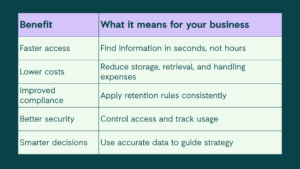
Organisations that digitise their information typically see a reduced time spent searching for documents, as staff can access what they need quickly through secure, searchable systems. This also leads to fewer compliance and audit issues, since records are governed consistently and retention rules are easier to apply.
With information no longer locked in silos, collaboration across teams improves, and businesses benefit from stronger continuity and resilience when information is protected, backed up, and accessible during disruptions.
Digital transformation turns information from a burden into a business asset.
How does information management enable digital transformation?
Information management provides the structure, governance, and control that make digital transformation sustainable and scalable.
Effective digital transformation requires:
- Information governance
Clear policies for retention, access, and disposal - Digitisation and indexing
Turning paper into searchable, structured data - Secure storage and access
Cloud and hybrid solutions with audit trails - Lifecycle management
Managing information from creation to secure destruction
Without these foundations, digital tools fail to deliver value.
Where Crown Information Management can help
Since 1965, Crown Information Management has been simplifying work for businesses in over 50 countries. We focus on practical transformation that delivers measurable outcomes.
Our approach
- Assess your information landscape
We start by understanding:
- What information you hold
- Where it lives
- How it is accessed and used
- What risks and inefficiencies exist
- Digitise what matters
Our scanning and digitisation services convert physical records into secure digital formats that integrate with your systems.
- Implement governance and control
We help define retention schedules, access rules, and compliance frameworks aligned with data laws and regulations.
- Enable ongoing transformation
Digital transformation is a journey, and we support long term information management through our various digital solutions, including:
- Document Scanning and Indexing
- ROT Data Management
- Digital Contract Management
- Information Consulting
Final thoughts
Digital transformation starts with information. Organisations that manage information well move faster, stay compliant, and perform better.
In 2026, success depends on how quickly and confidently your teams can access trusted information. By starting with information management, businesses lay the foundation for sustainable digital transformation.
FAQs
What is the first step in digital transformation?
The first step is understanding your current information landscape, including paper records, digital files, and compliance requirements.
Is digital transformation just about technology?
No. Digital transformation is about people, processes, and information. Technology only works when information is structured and governed properly.
How long does digital transformation take?
It varies by organisation. Many start seeing benefits within months by digitising priority records and improving access.
Is digital transformation required for compliance?
While not always mandatory, digital information management makes compliance with data protection and retention regulations far easier.
Can digital transformation reduce costs?
Yes. Organisations often reduce storage, retrieval, and administrative costs while improving productivity.