 International
  Bahrain
  Cambodia
  China
China  Hong Kong
  India
India  Indonesia
  Ireland
  Italy
Italy  Japan
Japan  Malaysia
  New Zealand
  Philippines
  Singapore
  South Africa
  Taiwan
  Thailand
  United Arab Emirates
  United Kingdom
  United States
  Vietnam
 -
Services --
-
- Digital Solutions
- Document Scanning and Indexing
- Digital Contract Management
- Digital Invoice Processing
- Digital Mailroom
- Employee Management System (HRDMS)
- Visitor Management System (VIZIO)
- Enterprise Content Management (ECM)
- Information Consulting
- Employee Onboarding
- Digital Signatures
- Fixed Asset Management
- Crown Cloud Services (Cloud Hosting)
- Workflow Automation
-
 Digital Solutions
  Records Management
  Secure Destruction
Contract management remains a major challenge for manufacturers, despite advances in digital systems. Contracts are scattered across multiple platforms, handled through manual processes and managed with inconsistent governance. As operational and regulatory pressures increase, these weaknesses expose organisations to unnecessary financial and commercial risk.
This blog explores why traditional storage methods and folder structures fail, and how context-driven information management offers a more intelligent alternative. By linking contracts to their purpose, relationships and workflows, manufacturers can achieve stronger control, clearer insight and measurable ROI.
Manufacturers across Ireland depend on contracts to manage suppliers, customers, services and operational commitments – yet the way these documents are stored and controlled is often fragmented and unreliable. Even organisations with modern ERP or collaboration tools still find contracts scattered across inboxes, shared drives, Teams sites and spreadsheets, making it difficult to identify the correct version or understand current obligations.
Manual approval steps, inconsistent renewal tracking and limited visibility further complicate matters, leaving teams exposed to risk and inefficiency.
So why does contract management repeatedly break down in manufacturing environments? What are the operational consequences, and how can a context-driven approach transform contract control, compliance and decision-making across an organisation?

Contracts Are Scattered Across Too Many Systems
Most manufacturers store contracts across a mix of SharePoint, Teams, email, ERP systems, supplier portals and network drives.
This fragmentation creates version confusion, duplicate files, slow searching and uncertainty over which document is the latest.
For manufacturers operating across multiple facilities, suppliers and international markets, this can become particularly challenging. Ireland’s manufacturing sector includes highly connected industries such as pharmaceuticals, medtech, food and beverage, engineering and technology, where information frequently needs to move between different teams, systems and external partners.
Fragmented systems can lead directly to inefficiency, duplicated effort and inconsistent information, making it harder for teams to trust the documents they use.
Manual Processes Slow Everything Down
Contract creation, review and approval often require emailing drafts back and forth or relying on individuals to remember renewal dates.
This leads to:
- Approval delays affecting operations
- Multiple “final” versions in circulation
- Missed renewals or undocumented commitments
Manual document handling can create errors, inefficiency and inconsistent document control across departments, particularly when multiple teams rely on email or local folders for version management.
For organisations working across different locations or with international suppliers, these manual processes can become even harder to manage consistently.
Compliance Pressure Makes Errors Costly
Manufacturers operating in Ireland often work within strict quality and regulatory frameworks, particularly across highly regulated industries such as pharmaceuticals, life sciences, medtech and food production.
Non-conformance can create significant financial, operational and reputational risk.
Disconnected documents and inconsistent approval processes make it difficult to demonstrate compliance with standards such as ISO 9001 or maintain audit-ready records. Organisations may also need to consider relevant Irish and EU regulatory requirements depending on their sector and the information contained within contracts.
Effective information management therefore requires unified workflows, appropriate access controls and reliable audit trails that make it easier to demonstrate how information has been created, reviewed, approved and retained.
Lack of Executive Visibility Increases Risk
When contracts are dispersed, leaders cannot easily answer fundamental questions:
- What obligations do we have with key suppliers?
- When do major contracts renew?
- Where are the risks or bottlenecks?
- Which contracts are underperforming?
Without a clear overview, decisions may be made without the full context – and that introduces commercial risk.
For manufacturers managing complex supply chains across Ireland, the EU and wider international markets, understanding contractual commitments can be particularly important when responding to changing costs, supplier disruption and regulatory requirements.

Why Traditional Approaches Don’t Solve the Problem
Adding more folders, more sites or more templates doesn’t fix contract management. Most systems are still designed around where a document sits, rather than what it is or how it connects to operations.
Traditional storage doesn’t answer:
- Who owns this contract?
- What product, site or supplier does it relate to?
- What is the renewal obligation?
- Is this the correct version?
- What risk category does it fall under?
Manufacturing needs something more intelligent, consistent and connected.
The Power of Context-Driven Document Management
Context-driven information management shifts the focus from location to meaning.
Instead of asking, “Where is the file saved?”, organisations can ask:
- What type of contract is this?
- Who is the supplier or customer?
- What is the renewal date?
- What site or process does it relate to?
- What workflow should it follow?
By classifying documents through metadata and relationships – rather than relying entirely on folders – manufacturers can create a more structured information environment.
Contracts can be connected to relevant suppliers, facilities, products, processes and responsibilities, making information easier to retrieve and understand.
This becomes increasingly important as manufacturers explore automation and AI. AI tools need access to reliable, structured and appropriately governed information to produce useful results.
Context-driven systems can help ensure AI works from accurate and consistent information rather than disconnected or outdated files.
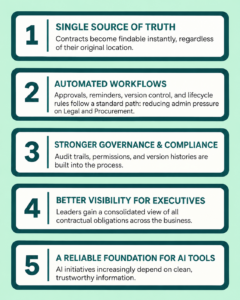
Context-driven systems can help ensure AI works from accurate and consistent information rather than disconnected or outdated files.

The ROI of Getting Contract Management Right
Manufacturers that move towards context-driven contract management can achieve returns across several areas:
- Faster Cycle Times
Automated workflows can replace manual chasing, helping to speed up approvals and reduce operational bottlenecks.
- Lower Risk and Fewer Missed Renewals
Centralised visibility can help prevent financial leakage, unplanned renewals and supplier disputes by making key dates and obligations easier to identify.
- Reduced Legal and Procurement Workload
Less time spent searching for, chasing or correcting documents allows legal, procurement and operational teams to focus on higher-value work.
- Improved Audit Readiness
Consistent metadata, document controls and audit trails can reduce the effort required to prepare for audits and demonstrate compliance.
- Better Supplier and Customer Alignment
Up-to-date contracts support smoother operations and clearer performance expectations across the supply chain.
When viewed across a full year, the combined productivity gains, reduced risk and improved decision-making can deliver meaningful and measurable value.
Conclusion: A More Intelligent Way Forward
Manufacturers don’t experience contract management problems because they lack systems. Often, the underlying problem is that information lacks sufficient structure, consistency and context.
For Irish manufacturers operating within increasingly digital, connected and regulated environments, gaining greater control over contractual information can support both day-to-day efficiency and longer-term resilience.
By adopting a context-driven approach to document management, organisations can move away from scattered files and manual workflows towards more consistent, controlled and insight-driven contract governance.
The goal isn’t simply to introduce another platform. It’s to ensure that contracts and the information surrounding them are reliable, accessible and connected to the wider business processes they support.
For organisations reviewing their approach to contract and document management, Crown Information Management Ireland works with businesses to understand how information is structured, governed and accessed across both physical and digital environments.
Ultimately, better contract management comes down to having the right information, in the right context, when it’s needed – giving organisations greater clarity to make informed and confident decisions.