 International
  Bahrain
  Cambodia
  China
China  Hong Kong
  India
India  Indonesia
  Ireland
  Italy
Italy  Japan
Japan  Malaysia
  New Zealand
  Philippines
  Singapore
  South Africa
  Taiwan
  Thailand
  United Arab Emirates
  United Kingdom
  United States
  Vietnam
  Document Management
  Digital Solutions
  Document Destruction
  E-waste & IT asset disposal
Data Erasure, Degaussing or Physical Destruction: Which ITAD Method Is Right for Your Business?
When a company retires old IT equipment, one question often comes up: what is the safest way to dispose of it?
The answer depends on the type of asset, the kind of data it may contain, the condition of the device and whether the company intends to reuse, recycle or permanently destroy it.
This is where IT Asset Disposition (ITAD) becomes important. It gives organisations a proper way to manage end-of-life IT assets while reducing data security, compliance and environmental risks.
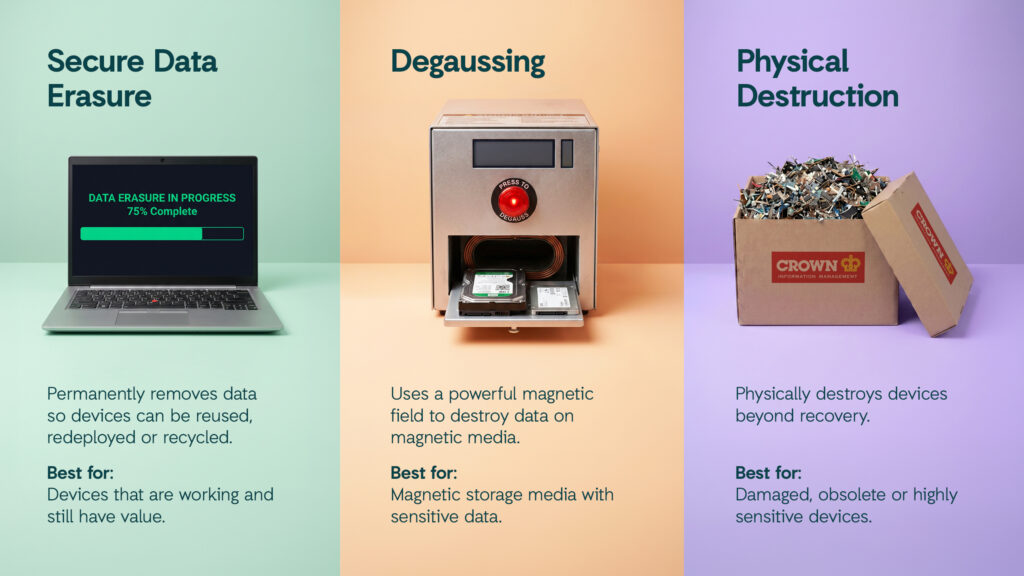
Three common methods are secure data erasure, degaussing and physical destruction. Each one serves a different purpose.
Why the Disposal Method Matters
Not every device should be handled in the same way. A laptop that may still be reused has different requirements from a damaged hard drive. A mobile phone may need a different process from a server. A storage device containing highly sensitive data may require a more final form of destruction.
The wrong method can leave risk behind. The right method helps ensure data is no longer recoverable and the asset is handled in a controlled way.
For businesses, this matters because IT disposal usually involves more than clearing space. It may involve customer data, employee records, financial information, contracts, emails, business plans and other confidential material.
What Is Secure Data Erasure?
Secure data erasure is the process of permanently removing data from a storage device so that it cannot be recovered.
This method is often suitable when a device may still have value and could be reused, redeployed, recycled or resold, subject to the company’s internal policy. It allows businesses to remove data without necessarily destroying the device itself.
Secure data erasure may be used for assets such as laptops, desktops, hard drives, SSDs, mobile phones and tablets, depending on the technology and condition of the device.
The main advantage is that the device can remain physically intact after the data has been sanitised. This can be useful for companies that want to extend asset value while still protecting sensitive information.
When Should Businesses Consider Secure Data Erasure?
Secure data erasure may be suitable when:
- Devices are still working
- The company wants to reuse or redeploy the asset
- The device may be returned, donated, recycled or resold
- There is a need for a record of erasure
- The business wants to reduce waste while maintaining data protection
For many companies, secure data erasure is a practical option when the device still has useful life. However, it must be carried out using proper tools and processes. Manual file deletion is not the same as secure erasure.
What Is Degaussing?
Degaussing is a method used to destroy data on magnetic storage media. It works by exposing the media to a powerful magnetic field, which disrupts the stored information.
This method is commonly associated with magnetic storage devices and media. Once degaussing is done, the device or media is usually no longer usable.
Degaussing may be suitable when the goal is to make stored data unrecoverable and there is no intention to reuse the storage media.
When Should Businesses Consider Degaussing?
Degaussing may be suitable when:
- The asset contains magnetic storage media
- The data is highly sensitive
- Reuse is not required
- The company wants a permanent data destruction method
- The storage media must be made unreadable
Degaussing is a strong option for certain types of storage media, but it is not suitable for every device. This is why companies should assess the asset type before choosing the method.
What Is Physical Device Destruction?
Physical destruction means the device or storage media is physically damaged beyond practical recovery. This may involve shredding, crushing or other destruction methods, depending on the asset and service provider.
Physical destruction is often used when devices are obsolete, damaged, no longer required or considered too sensitive for reuse.
For many organisations, this is the most straightforward option when there is no reason to preserve the asset.
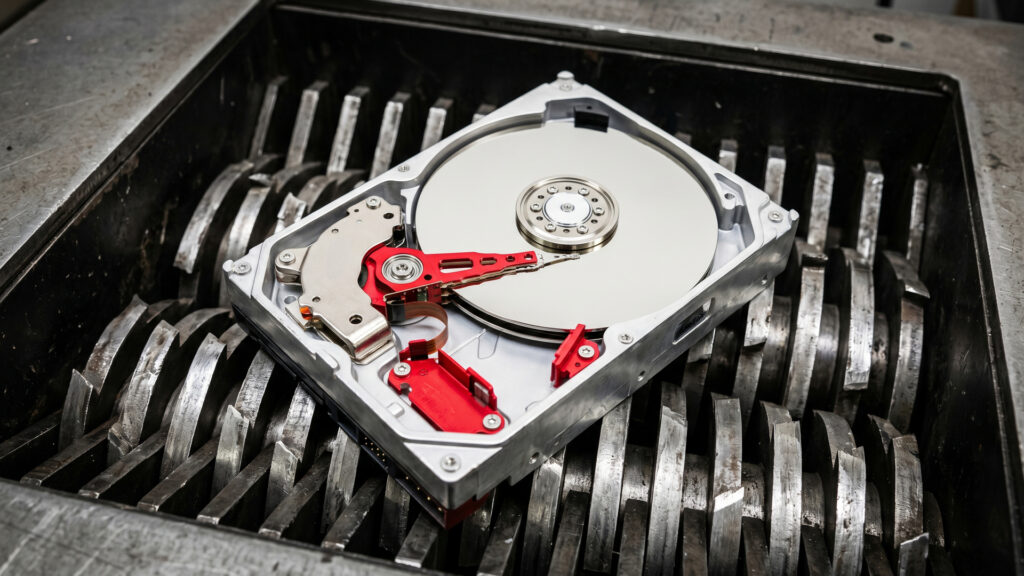
When Should Businesses Consider Physical Destruction?
Physical destruction may be suitable when:
- Devices are damaged or obsolete
- The company does not want the asset reused
- The asset may contain sensitive business data
- The business wants a clear end-of-life disposal process
- The organisation needs documentation for disposal records
This method is especially useful for hard drives, old laptops, phones, servers and storage devices that no longer serve a business purpose.
Simple Guide: Which ITAD Method Should You Choose?
| Situation | Suggested ITAD Direction |
| Device may be reused internally | Secure data erasure |
| Device may be recycled or resold | Secure data erasure, if suitable |
| Magnetic storage media needs permanent sanitisation | Degaussing |
| Device is damaged, obsolete or no longer needed | Physical destruction |
| Highly sensitive data is involved | Degaussing or physical destruction |
| Audit records are required | Choose a provider that can support documentation |
| Small office batch of unwanted devices | Device Destruction package may be a practical option |
Note: This table should be used as a general guide only. The right method depends on the device type, data sensitivity, internal policy and disposal objective.
Why Informal Disposal Is Risky
Some companies dispose of old IT assets through informal channels because it seems faster. The problem is that once the device leaves the office, the company may no longer know where it goes, who handles it or whether the data inside has been properly destroyed.
This can create several risks:
- Unauthorised access to business data
- Lack of proof that data was destroyed
- Poor environmental handling
- Weak audit trail
- Inconsistent disposal practices across departments
How Crown Information Management Malaysia Supports ITAD
Crown Information Management Malaysia provides secure ITAD solutions for companies that need to manage e-waste, data-bearing devices and end-of-life IT equipment.
Depending on the asset and requirement, Crown can support secure data erasure, degaussing and physical destruction to help businesses reduce data security risk and dispose of devices responsibly.
For corporate teams managing old equipment, this gives a more structured alternative to leaving devices in storage or disposing of them through unverified channels.
There is no single ITAD method that fits every device. Secure data erasure, degaussing and physical destruction each have a role. The safest approach is to understand what devices you have, what data they may contain and what your organisation needs to achieve after disposal. From there, the right method becomes much clearer.
Old devices should not leave the business casually. They should leave with control, documentation and the confidence that the data risk has been properly addressed.
Ready to Dispose of Old IT Assets Securely?
Old laptops, hard drives, phones, servers and other office devices may still contain confidential business information. Crown helps organisations manage end-of-life IT equipment through secure data erasure, degaussing, physical destruction and responsible e-waste disposal.