 International
  Bahrain
  Cambodia
  China
China  Hong Kong
  India
India  Indonesia
  Ireland
  Italy
Italy  Japan
Japan  Malaysia
  New Zealand
  Philippines
  Singapore
  South Africa
  Taiwan
  Thailand
  United Arab Emirates
  United Kingdom
  United States
  Vietnam
 -
Services --
-
- Digital Solutions
- Document Scanning and Indexing
- Digital Contract Management
- Digital Invoice Processing
- Digital Mailroom
- Employee Management System (HRDMS)
- Visitor Management System (VIZIO)
- Enterprise Content Management (ECM)
- Information Consulting
- Employee Onboarding
- Central Know Your Customer Automation (CKYC)
- Digital Signatures
- Fixed Asset Management
- Digital file tracking (DART)
 Records Management
  Digital Solutions
  Secure Destruction
  By Industry
  ECM
ECM  DMS
DMS  Data Capture
  Workflow Automation
For years, digitization meant one thing: taking paper and making it digital. Scan a document, save it as a PDF, move on. That approach solved the storage problem but left a bigger one untouched. The information inside those files remained essentially invisible, locked inside image files that computers could not read, search, or act on. For organizations managing large volumes of records, that gap between “digitized” and “usable” has real consequences. AI is closing that gap, and quickly, and we’re sitting at the intersection of it: handling both physical records at scale and digitization initiatives at scale.
The problem with traditional scanning
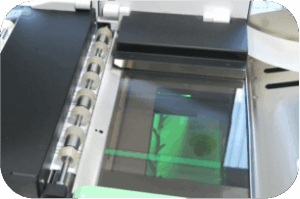 A scanned document is, at its core, a photograph of text. The file exists digitally. You cannot search for a specific clause in a contract, pull a date from an invoice, or run compliance checks against a folder of scanned HR records without opening each file manually. As The AI Journal notes, millions of businesses digitized their paper records years ago, yet employees still waste hours every week searching through folders, renaming files, and manually sorting documents (something we’ve talked about many times before, discoverability might sound boring but it costs the global economy countless billions). The files exist digitally, but the information inside them remains locked away.
The scale of the challenge is larger than many organizations expect. Doxis’ 2025 IDP market study found that 61% of document processes still involve paper, and 48% of enterprises expect their paper use to increase despite years of digital-first initiatives. That reliance on paper carries real costs in retrieval time, storage overhead, data entry errors, and compliance risk.
So what does AI actually do differently?
Modern AI-powered document processing does something fundamentally different from traditional scanning. Rather than creating an image of a document, these systems interpret the content within it. They read, classify, and extract information automatically, turning static files into structured, searchable, actionable data.
This is made possible by a combination of technologies: Optical Character Recognition (OCR) to convert printed or handwritten text into machine-readable formats, Natural Language Processing (NLP) to understand context and meaning, and machine learning models that improve over time. Together, they form what the industry calls Intelligent Document Processing, or IDP.
The ambition behind these systems is significant. As idp-software.com reports, NVIDIA’s Nemotron Parse models represent this evolution, moving beyond ‘simple text scraping’ to systems that interpret documents ‘as a human would by recognizing structure, relationships and context.’ That shift from pixel recognition to genuine document understanding is what separates current AI tools from the OCR technology of a decade ago.
The business case in numbers
The adoption numbers reflect genuine results rather than hype. According to research compiled by Sci-Tech Today, IDP reduces document processing time by 60% to 70% compared to manual workflows, and companies using advanced IDP systems achieve a return on investment of between 200% and 300% within the first year of deployment. AI-driven platforms are reaching data extraction accuracy rates of up to 99% for structured and semi-structured documents.
Adoption at the enterprise level is accelerating accordingly: 63% of Fortune 250 companies have already implemented IDP solutions, according to Docsumo, with the financial sector leading at 71% adoption. The market reflects that momentum: Fortune Business Insights valued the global IDP market at $10.41 billion in 2025 and projects it will reach $88.91 billion by 2034, growing at a compound annual rate of 26.8%.
Crown sits in a very strong position at the intersection of physical records management, digitisation and digital transformation. The question is no longer “How many documents can we scan?” but rather “How much value can we extract from the information we already hold?” By combining secure records management, intelligent capture, content services, and AI-driven processing, we can help customers transform archives from passive storage assets into active sources of operational intelligence, and compliance insight, to gain real business advantage. This shift from storage to intelligence is where the future of the industry is increasingly heading.
- David Fathers, Regional Director Crown U.K. and Ireland
Where this matters for records management
For organizations in the records management space, the implications are practical and immediate. Scanning a box of paper files has always been the first step, not the destination. The real value lies in what happens after: being able to retrieve, cross-reference, and act on that information without manual intervention.
AI changes that calculus. A scanned invoice can be automatically classified, have its key fields extracted, and be routed for approval without a person touching it. A digitized HR file can be indexed by employee, date range, and document type in seconds. Legal and compliance records can be flagged for retention schedules automatically, reducing the risk of either premature destruction or unnecessary long-term storage.
The benefits compound at scale. Organizations processing hundreds of thousands of pages each year see the greatest gains, but even smaller operations benefit from the shift away from manual indexing and the errors that come with it. idp-software.com reports that intelligent automation is achieving over 99% accuracy in automatic data capture, with systems capable of delivering up to 80% reduction in repetitive manual tasks.
What to look for in an AI-powered digitization solution
Not all AI document tools are built the same. When evaluating a solution, organizations should look beyond OCR accuracy and consider whether the system can handle the variety of documents they actually work with: handwritten notes, mixed-format files, low-quality legacy scans, and multi-language content.
Integration matters as much as extraction. A system that can identify and classify documents but cannot connect to existing records management platforms, ERP systems, or compliance workflows creates new silos rather than eliminating old ones. Cloud compatibility, role-based access controls, and audit trail functionality are also worth evaluating, particularly for organizations operating under regulatory requirements.
Security considerations deserve early attention. AI systems trained on document data raise questions about where that data goes, who can access it, and how models are updated. Organizations handling sensitive records need clear answers from any vendor before committing.
The shift from storage to smart LLM discoverability
Digitization was never really about paper. It has always been about access to find information when you need it, share it securely, and trust that it is accurate. Traditional scanning delivered the first part. AI is delivering the rest.
For organizations still measuring digitization success by volume of pages scanned, the next step is to ask a different question: what can we actually do with that information now? The technology to answer it is now here.
Get in touch today and start using your legacy records to make your systems more intelligent as you go. We’ve been working with, storing and archiving physical and digital records for decades, and are uniquely placed to help you get started.
